5 Basic Tai Chi Movements Every Beginner Should Learn
Every Tai Chi journey begins with a few simple movements, and mastering just a handful of them gives you a foundation you’ll build on for years. The five movements below are drawn from the beginner-friendly Yang-style form and are among the first that new practitioners learn. Take them slowly, one at a time, and you’ll have a short, satisfying practice you can do anywhere. A quick note before you begin: written descriptions are a wonderful starting point, but Tai Chi is felt as much as it’s read. Use these as a guide, move gently, and never force anything. When you’re ready to see the movements demonstrated and refined, follow-along instruction (see the end of this article) will take you much further.
Before You Start: Set Your Foundation
Before any movement, take a moment to set up your posture and breath, the two ingredients that turn simple motions into Tai Chi. Stand with your feet about shoulder-width apart, knees softly bent, spine long, shoulders relaxed, and the crown of your head gently lifted as if suspended by a thread. Breathe slowly through your nose, letting your lower belly expand, the foundation of what’s called Dan Tian breathing. (For a fuller walkthrough, see our guide on how to start Tai Chi at home.) Now you’re ready.
- Movement 1: Commencement (The Opening) This is how nearly every Tai Chi practice begins; it’s a simple, calming movement that centers your body and mind. Standing in your foundation posture, slowly raise both arms forward to about shoulder height on an inhale, keeping the shoulders relaxed and the elbows soft. Then, on an exhale, gently draw the elbows down and lower your hands back toward your waist, as if pressing down slowly through calm water. Repeat several times. Commencement teaches you the essence of Tai Chi in miniature: slow, continuous, relaxed movement linked to the breath.
- Movement 2: Parting the Wild Horse’s Mane A flowing, weight-shifting movement that builds balance and coordination between your upper and lower body. Begin by shifting your weight onto one leg and imagining you’re holding a large, light ball in front of your body, one hand above, one below. Step gently forward and to the side with your free foot, shifting your weight onto it as you slowly “part” your hands: the lower hand rises outward and upward to about shoulder height, while the upper hand lowers softly toward your hip. The motion resembles gently separating a horse’s flowing mane. Return to holding the ball and repeat on the other side. Move slowly and let your waist guide the turn.
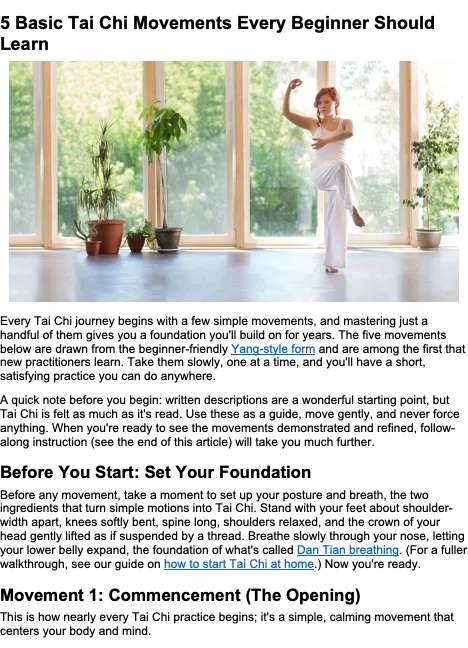
- Movement 3: White Crane Spreads Its Wings An elegant, balancing movement that opens the chest and cultivates poise. From a stable stance, shift your weight fully onto your back foot and lightly touch the toes of your front foot to the floor. As you settle your weight, let one hand float up and open near the side of your head (palm facing outward, like a crane lifting a wing) while the other hand lowers gently to rest near your hip. Your posture becomes tall, open, and light. This movement teaches balance on one leg and the graceful “opening” quality that Tai Chi is known for. Move into it slowly and keep your standing knee soft.
- Movement 4: Wave Hands Like Clouds (Cloud Hands) A soft, continuous, side-to-side movement that many practitioners find deeply relaxing and almost meditative. Standing with your weight comfortably centered, let your waist turn slowly from side to side. As your body turns one way, your hands trace gentle circles in front of you, one hand higher (around chest or face height) and one lower (around the waist), palms softly rotating as if smoothing the surface of a cloud. As you turn to the other side, the hands trade positions in a flowing, unbroken circle. Let the turning come from your waist, not your arms, and keep everything slow and connected. Cloud Hands beautifully develops waist movement, coordination, and calm.
- Movement 5: Closing Form (Gathering the Energy) Just as every practice opens, it also closes, with a quiet, gathering movement that settles you before you finish. From a centered stance, bring your hands together in front of your lower abdomen in a slow, gentle motion, as if drawing your energy inward and settling it. Let your breathing slow, your shoulders soften, and your mind quiet. Stand still for a moment at the end, simply noticing how your body and mind feel. This closing is more than a formality; it’s where the calm of your practice sinks in and stays with you.
Putting Them Together
Once each movement feels reasonably smooth on its own, try flowing gently from one into the next: open with Commencement, move through Parting the Wild Horse’s Mane, White Crane Spreads Its Wings, and Cloud Hands, then settle with the Closing Form. Even this short sequence, practiced slowly and mindfully, is a complete and nourishing Tai Chi session. Remember: quality over quantity, and slow over fast, every time.
Common Questions About Basic Tai Chi Movements
What are the best Tai Chi movements for beginners? Foundational movements like Commencement, Parting the Wild Horse’s Mane, White Crane Spreads Its Wings, Cloud Hands, and the Closing Form are ideal starting points. They’re simple, safe, and teach the core qualities of relaxed, balanced movement.
Can I learn Tai Chi movements from written instructions? Written guides are a great orientation, but Tai Chi is best learned by watching and following along, since so much depends on feel, timing, and subtle body position. Pairing these descriptions with video instruction works wonderfully.
How many times should I repeat each movement? There’s no fixed number. Repeat each movement slowly several times until it begins to feel smooth. Consistency and relaxed attention matter more than counting reps.
Do I need to memorize a whole form to benefit? Not at all. Even a few well-practiced movements provide real relaxation, balance, and focus benefits, especially when paired with a gentle Qi Gong warm-up. A short, simple sequence is a complete practice.
Which style are these movements from? These are drawn from the popular Yang style, and the simplified 24-form in particular, the most common and beginner-friendly starting point in Tai Chi.
Ready for the Full Form? Join Tai Chi Mastery
These five movements are your foundation, and the natural next step is to see them demonstrated in detail and build toward the complete form. Tai Chi Mastery is SOHMA’s online membership that guides you step by step from these very first movements all the way through the complete Yang-style form, under the instruction of Chief Instructor Dr. Daniel Hoover. With clear, follow-along lessons you can practice and replay anytime, you’ll refine each movement and confidently expand your practice, one step at a time.
Explore the Tai Chi Mastery membership and learn the full form today.
About Dr. Daniel Hoover
Dr. Daniel Hoover, DC, LAc, MH, CCSP®, integrates a rare fusion of clinical expertise and martial mastery to elevate the health of his patients and students. As a Doctor of Chiropractic, Licensed Acupuncturist, and 5th degree black belt in Shaolin Kempo, Dr. Hoover serves as the Chief Tai Chi Chuan instructor at the School of Healing Martial Arts™. His journey as an Ironman and Master Herbalist informs his unique understanding of how the body thrives under disciplined practice. To expand his impact beyond the local clinic, Dr. Hoover developed online Tai Chi courses, making these traditional healing arts accessible for any wellness journey. If you are ready to begin, we invite you to explore Tai Chi Mastery under the expert guidance of Dr. Daniel Hoover.