What Does the Yin-Yang Symbol Mean in Tai Chi?
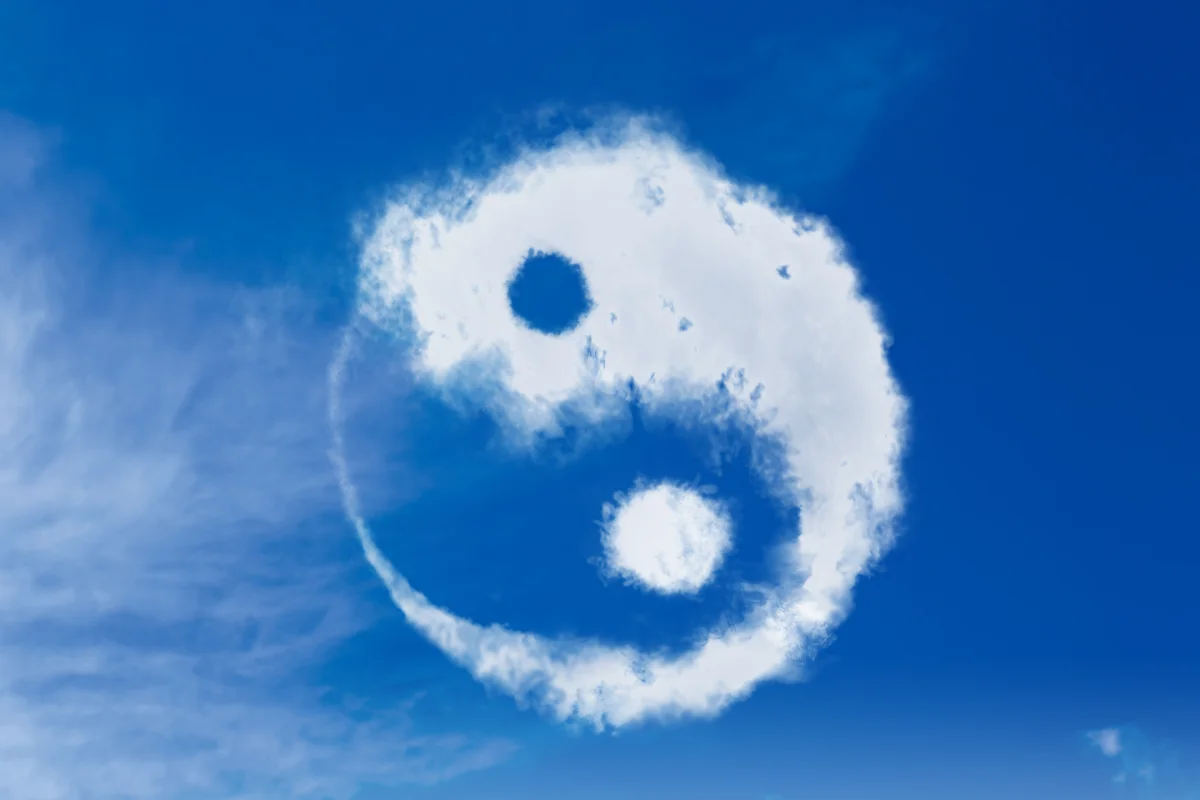
You’ve seen it everywhere: the flowing circle divided into swirling black and white halves, each cradling a small dot of the opposite color. It’s one of the most recognizable symbols in the world, and it isn’t just decoration for Tai Chi. It is Tai Chi, in a single image. This symbol expresses the entire philosophy behind the practice, and understanding it will change how you move. Let’s explore what it really means.
The Symbol and Its Name
The familiar black-and-white circle is properly called the taijitu, which translates to “diagram of the supreme ultimate.” That phrase is the key: the very word Tai Chi (or taiji) means “supreme ultimate,” and this symbol is its diagram. In other words, the yin-yang symbol is the picture of the exact principle your practice is named after.
Within the circle, the two swirling halves represent yin and yang, the two complementary forces whose interplay, in Chinese philosophy, gives rise to all of existence.
What Do Yin and Yang Mean?
Yin and yang describe how seemingly opposite forces are actually complementary, interconnected, and interdependent. Neither is “good” or “bad”; they’re two sides of a single whole, the same forces at play in Qi itself.
- Yin is associated with qualities like softness, stillness, yielding, receptivity, darkness, and the earth.
- Yang is associated with qualities like firmness, movement, activity, assertiveness, light, and the heavens.
Traditionally, yin is represented by the dark half of the symbol and yang by the light half. But the symbol says far more than “opposites exist.” Look closely and you’ll notice its deeper teachings.
The Deeper Lessons Hidden in the Symbol
The taijitu is beautifully designed to convey several truths at once: Balance and wholeness. The two halves together form one complete, harmonious circle. Neither dominates; each takes up exactly half. This is the image of perfect balance.
Interdependence. The halves don’t sit side by side like a pie cut in two, they curve into and around each other, showing that yin and yang are intertwined and define one another. There is no light without dark, no stillness without movement.
The seed of each in the other. That small dot of the opposite color in each half is the most profound detail. It tells us that within yin there is always a seed of yang, and within yang a seed of yin. Nothing is ever purely one thing.
Constant flow. The swirling, S-shaped curve suggests continuous motion, yin flowing into yang and back again, endlessly. The balance isn’t static; it’s a living, dynamic dance.
How Yin and Yang Show Up in Your Tai Chi Practice
Here’s where philosophy becomes physical. Yin and yang aren’t abstract ideas in Tai Chi, they’re present in every single movement:
- Full and empty (substantial and insubstantial). At almost every moment in Tai Chi, most of your weight rests on one “full” (yang) leg while the other stays “empty” (yin). Learning to clearly distinguish full from empty is one of the most important skills in the art, and it’s yin-yang in action, a skill you build directly in the Yang style 24 form.
- Softness and firmness. Tai Chi is famous for being soft yet powerful, yielding like water (yin) while capable of expressing strength (yang). The two coexist.
- Opening and closing. Movements continuously expand (yang) and gather (yin), like breathing made visible, the same rhythm you cultivate through Dan Tian breathing.
- Stillness and motion. Even in the flowing form, there’s calm stillness within the movement, quiet at the center of activity, rooted in your Dan Tian.
- Inhale and exhale. The breath itself is a yin-yang cycle, rising and falling with your movement. When you watch a skilled practitioner and sense that their Tai Chi looks perfectly balanced, soft yet grounded, still yet flowing, effortless yet powerful, you’re watching yin and yang in harmony. That harmony is the whole goal, visible even in the five basic movements every beginner learns.
The Takeaway for Your Practice
The yin-yang symbol is a constant reminder of what you’re cultivating: balance, not force; harmony, not domination; flow, not rigidity. Whenever your practice feels too stiff, too effortful, or off-kilter, the symbol offers a gentle correction, soften where you’re overly hard, ground where you’re too light, and let the opposites in your movement find their balance. In this way, the taijitu isn’t just Tai Chi’s logo. It’s its deepest instruction.
Common Questions About the Yin-Yang Symbol
What is the Tai Chi symbol called? It’s called the taijitu, meaning “diagram of the supreme ultimate.” Most people know it simply as the yin-yang symbol.
What do the two dots in the yin-yang symbol mean? Each dot represents the seed of the opposite force, a reminder that within yin there is always some yang, and within yang always some yin. Nothing is ever purely one thing.
Why is the yin-yang symbol associated with Tai Chi? Because the words Tai Chi (taiji) mean “supreme ultimate,” and the symbol is literally the diagram of that concept. It represents the balance and harmony of opposites that the practice cultivates.
What do yin and yang represent? They represent complementary opposites, yin as softness, stillness, and yielding; yang as firmness, movement, and activity, that together form a balanced, interconnected whole.
How does yin-yang apply to Tai Chi movements? It appears constantly: full and empty weight in the legs, softness and firmness, opening and closing, stillness within motion, and the rise and fall of the breath. Balancing these is central to the practice.
Feel the Balance for Yourself with Tai Chi Mastery
The harmony of yin and yang isn’t just something to understand, it’s something to feel in your own movement. Tai Chi Mastery is SOHMA’s online membership that teaches you to balance softness and strength, stillness and motion, full and empty, step by step, under the instruction of Chief Instructor Dr. Daniel Hoover.
You’ll learn to move with the balanced, flowing quality the taijitu represents, at your own pace, with lessons you can replay anytime.
Explore the Tai Chi Mastery membership and begin today.
About Dr. Daniel Hoover
Dr. Daniel Hoover, DC, LAc, MH, CCSP®, integrates a rare fusion of clinical expertise and martial mastery to elevate the health of his patients and students. As a Doctor of Chiropractic, Licensed Acupuncturist, and 5th degree black belt in Shaolin Kempo, Dr. Hoover serves as the Chief Tai Chi Chuan instructor at the School of Healing Martial Arts™. His journey as an Ironman and Master Herbalist informs his unique understanding of how the body thrives under disciplined practice. To expand his impact beyond the local clinic, Dr. Hoover developed online Tai Chi courses, making these traditional healing arts accessible for any wellness journey. If you are ready to begin, we invite you to explore Tai Chi Mastery under the expert guidance of Dr. Daniel Hoover.