What Is Ba Duan Jin (the 8 Brocades)? A Complete Guide
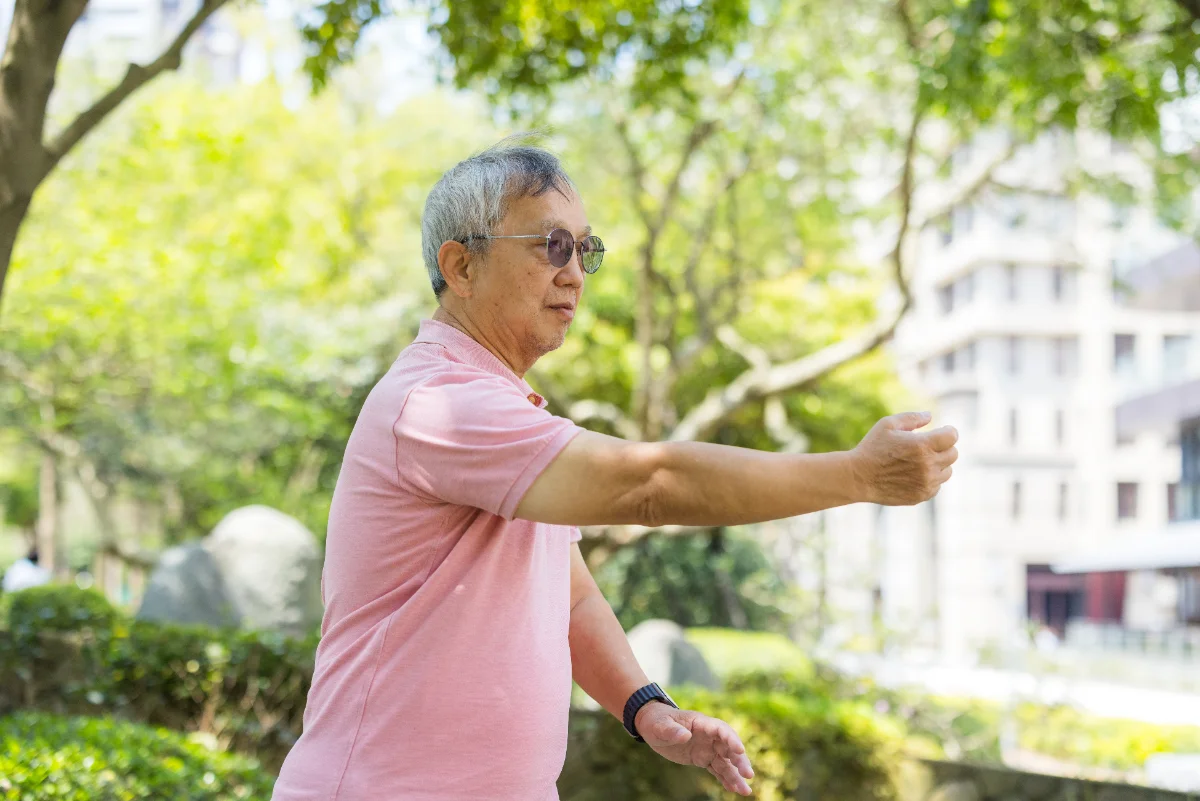
Of all the Qi Gong sets practiced around the world, none is more widespread or beloved than Ba Duan Jin, the Eight Brocades. Walk through a park in China at dawn and you’ll see people of every age flowing through its eight gentle movements. It’s one of the sets we draw on at SOHMA, and it makes a superb standalone practice as well as a warm-up for Tai Chi. Here’s everything a beginner needs to know.
What Is Ba Duan Jin?
Ba Duan Jin is a traditional Qi Gong routine made up of eight distinct movements, each designed to gently work a different part of the body and support the flow of energy, the same Qi cultivated throughout Tai Chi. The name translates to “Eight Pieces of Brocade” (or “Eight Silken Movements”), a poetic image suggesting something refined, flowing, and precious, like fine silk. The full set takes only about ten to fifteen minutes to complete, requires no equipment, and can be practiced almost anywhere. Each of the eight movements is simple, repeated a handful of times, and performed slowly with coordinated breathing. That combination of simplicity and depth is exactly why it has endured for so long.
A Thousand-Year-Old Practice
Ba Duan Jin is often traced back roughly a thousand years, with tradition attributing its origins to General Yue Fei of the Song Dynasty, who is said to have developed the movements to keep his soldiers healthy and strong. Whether or not every detail of that legend is historically precise, the set is unquestionably ancient, and it has been passed down through many teachers and lineages over the centuries, which is why you’ll find several slightly different versions today.
In the early 2000s, a standardized version was published by the Chinese Health Qigong Association to make the practice consistent and widely accessible, and this modern standardized form is now the most commonly taught worldwide. Traditional lineage versions remain equally valid and continue to be practiced.
The Eight Movements
Each of the eight “brocades” has a wonderfully evocative traditional name that hints at its shape and purpose. While the exact choreography is best learned by following along visually, here’s an overview of the classic sequence so you know what to expect:
- Holding Up the Heavens: arms rise overhead to stretch and open the whole body and, traditionally, to regulate the “Triple Burner.”
- Drawing the Bow: the arms extend to the sides as if drawing a bow and arrow, opening the chest and strengthening the upper body.
- Separating Heaven and Earth: one hand presses upward while the other presses down, said to benefit the stomach and spleen.
- Looking Back: a gentle turn of the head and upper body to each side, easing neck and back tension.
- Swaying the Head and Tail: a relaxed, sweeping movement of the torso, traditionally used to calm excess “heart fire” and settle the mind.
- Reaching Down to the Feet: a slow forward fold that stretches the back of the body and strengthens the lower back and legs.
- Punching with Fierce Eyes: the one more vigorous movement, delivering slow, controlled punches to build strength and vitality.
- Bouncing on the Toes: a gentle rise and drop onto the heels to close the practice and, as tradition says, “shake off” illness.
The Benefits of Ba Duan Jin
Ba Duan Jin is prized for offering a lot of benefit from a small time investment. Practitioners and a growing body of research associate it with:
- Improved flexibility and mobility through the shoulders, spine, hips, and legs.
- Better posture and balance.
- Reduced stress and a calmer, more regulated nervous system, similar to how Tai Chi is used for mood improvement.
- Slower, deeper, more efficient breathing.
- Increased energy and vitality.
- Support for cardiovascular and metabolic health, with studies exploring benefits for markers like blood pressure and blood-sugar regulation.
Because it’s gentle, low-impact, and easily modified, Ba Duan Jin suits a very wide range of ages and abilities. As with any new practice, if you have a health condition or are pregnant, check with your healthcare provider first, and never push into pain.
Why It Pairs So Well with Tai Chi
Ba Duan Jin and Tai Chi are natural partners. The Eight Brocades gently open the joints, settle the breath, and cultivate the relaxed body awareness that Tai Chi depends on, which is exactly why it makes such an excellent warm-up. Learn the Eight Brocades and you’re not only gaining a complete practice in its own right; you’re laying a beautiful foundation for your Tai Chi, such as the Yang style 24 form.
Common Questions About Ba Duan Jin
How do you pronounce “Ba Duan Jin”? It’s pronounced roughly “bah dwahn jin.” In English it’s most often called the “Eight Brocades” or “Eight Pieces of Brocade.”
How long does it take to do the Eight Brocades? The full set of eight movements typically takes about ten to fifteen minutes, depending on how many repetitions you do.
Is Ba Duan Jin Tai Chi or Qi Gong? It’s a Qi Gong set, a sequence of eight energy-cultivation movements. It’s often practiced alongside Tai Chi and makes an excellent warm-up for it.
Is Ba Duan Jin good for beginners? Yes. Its eight movements are simple, gentle, and easy to learn, making it one of the most beginner-friendly Qi Gong sets in the world, much like the basic movements beginners learn in Tai Chi.
Can I practice the Eight Brocades every day? Yes. Because it’s gentle and low-impact, many people practice Ba Duan Jin daily. Its short length makes it easy to fit into a routine.
Learn the Eight Brocades with Tai Chi Mastery
Ba Duan Jin is best learned by watching and following each movement closely, and having an expert guide you ensures you get the details right. Tai Chi Mastery is SOHMA’s online membership that guides you through gentle Qi Gong and the complete Yang style Tai Chi form, step by step, under the instruction of Chief Instructor Dr. Daniel Hoover.
Whether you want the Eight Brocades as a standalone practice or as the perfect warm-up for your Tai Chi, you’ll learn it clearly and correctly, at your own pace.
Explore the Tai Chi Mastery membership and start practicing today.
About Dr. Daniel Hoover
Dr. Daniel Hoover, DC, LAc, MH, CCSP®, integrates a rare fusion of clinical expertise and martial mastery to elevate the health of his patients and students. As a Doctor of Chiropractic, Licensed Acupuncturist, and 5th degree black belt in Shaolin Kempo, Dr. Hoover serves as the Chief Tai Chi Chuan instructor at the School of Healing Martial Arts™. His journey as an Ironman and Master Herbalist informs his unique understanding of how the body thrives under disciplined practice. To expand his impact beyond the local clinic, Dr. Hoover developed online Tai Chi courses, making these traditional healing arts accessible for any wellness journey. If you are ready to begin, we invite you to explore Tai Chi Mastery under the expert guidance of Dr. Daniel Hoover.