
What Is Qi Gong? A Beginner's Guide to Energy Cultivation
If you’ve explored Tai Chi, you’ve almost certainly encountered its close cousin: Qi Gong (also spelled chi kung or qigong). The two are often taught together, at SOHMA, gentle Qi Gong is woven right into practice, yet many beginners aren’t quite sure what Qi Gong actually is or how it differs from Tai Chi. This guide clears it up in plain language.
What Is Qi Gong?
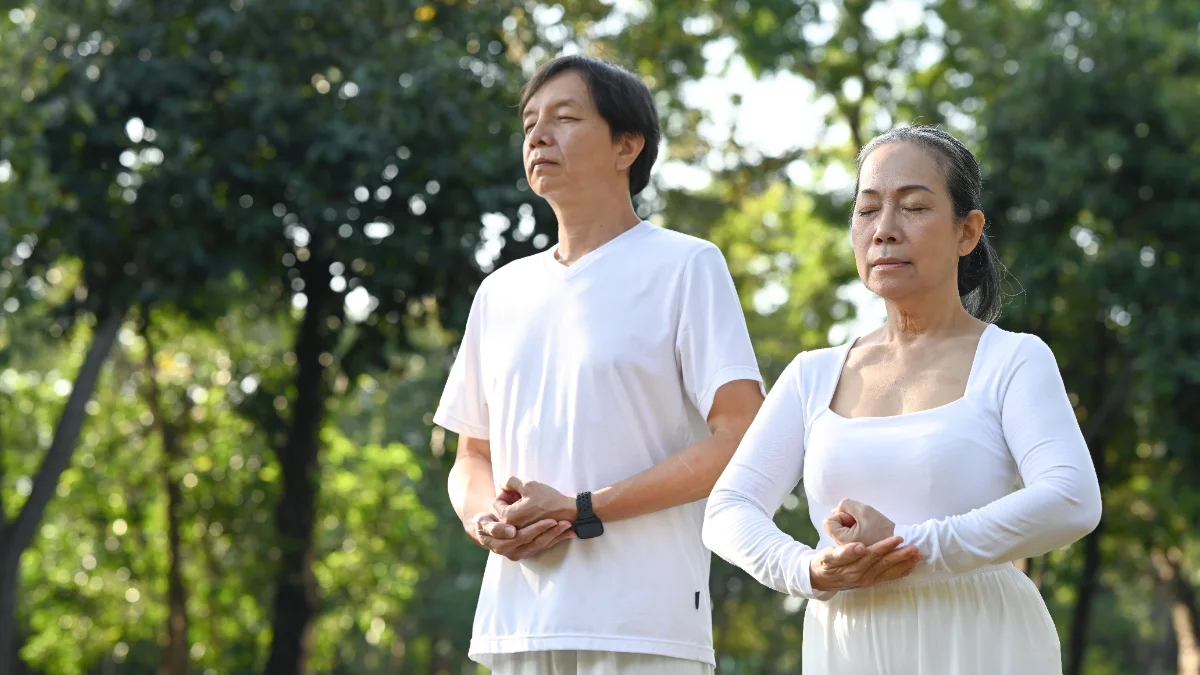
Qi Gong is an ancient Chinese practice that combines gentle movement, breath control, and focused attention to cultivate and balance the body’s vital energy, often centered on the Dan Tian. The name says it all: qi (pronounced “chee”) means life energy or vital force, and gong means skill developed through steady, dedicated practice. Put them together and Qi Gong translates roughly to “the skill of cultivating life energy.”
In practical terms, a Qi Gong practice usually involves slow, flowing or repetitive movements, sometimes done standing, sometimes seated, sometimes held as still postures, coordinated with slow breathing and a calm, present mind. Some Qi Gong is dynamic and physical; some is soft and almost meditative. All of it aims to promote the smooth flow of energy, relaxation, and health.
A Very Old Practice
Qi Gong is thousands of years old, with roots deep in Chinese medicine, philosophy, and martial traditions. Over the centuries, countless styles and sets developed, practiced by physicians for health, by monks for spiritual cultivation, and by martial artists for strength and vitality. One of the most famous and beloved sets is the Ba Duan Jin, or Eight Brocades, a sequence of eight gentle movements still practiced around the world today.
While Qi Gong grew from traditional Chinese concepts of energy and meridians, you don’t need to adopt any particular belief system to benefit from it. Many people simply experience it as a wonderfully calming, restorative form of gentle movement and breathing.
Qi Gong vs. Tai Chi: What’s the Difference?
This is the question nearly every beginner asks, and it’s a great one. Tai Chi and Qi Gong are closely related, both use slow movement, breath, and mindful focus, and both come from the same rich tradition, but there’s a helpful distinction:
- Tai Chi is, at its heart, a martial art expressed as a specific, choreographed form, a set sequence of connected movements (like the 24 form) that also carries self-defense principles.
- Qi Gong is broader and simpler. It’s a category of energy-cultivation exercises, often made of individual movements repeated on their own rather than a single long choreographed sequence. It’s generally easier to learn and less focused on martial application.
A useful way to think about it: much of Tai Chi could be described as “Qi Gong in motion, organized into a martial form.” Qi Gong is often the gentler, more accessible entry point, while Tai Chi adds the depth and structure of a complete form. Many practitioners, and many schools, including SOHMA, practice both, using Qi Gong to warm up, relax, and build energy awareness that carries directly into their Tai Chi.
The Benefits of Qi Gong
Regular Qi Gong practice is associated with a wide range of benefits, including:
- Reduced stress and a calmer mind, thanks to its emphasis on slow breathing and relaxation, similar to how Tai Chi is used for mood improvement.
- Improved flexibility, posture, and mobility from its gentle stretching and joint movement.
- Better balance and coordination.
- More energy and vitality, as the practice is designed to cultivate and circulate qi.
- Support for overall well-being, which is why forms of Qi Gong are increasingly used in integrative and complementary health settings.
As always, Qi Gong is gentle and widely considered safe, but if you have a health condition or are pregnant, it’s wise to check with your healthcare provider before starting any new practice.
How to Get Started with Qi Gong
The beauty of Qi Gong is its accessibility. You can begin with a single simple movement, done slowly and repeated a handful of times while breathing calmly. Because many Qi Gong exercises are stand-alone and can even be done seated, it’s a wonderful practice for almost any age or fitness level. A structured set like the Eight Brocades is a perfect, time-tested place to begin, and it doubles beautifully as a warm-up for Tai Chi.
Common Questions About Qi Gong
How do you pronounce “Qi Gong”? It’s pronounced roughly “chee gong.” You may also see it written as chi kung or qigong, all refer to the same practice.
Is Qi Gong the same as Tai Chi? No, but they’re closely related. Tai Chi is a martial art performed as a choreographed form, while Qi Gong is a broader category of gentler energy-cultivation exercises. Many people practice both together.
Is Qi Gong easier than Tai Chi? Generally, yes. Qi Gong movements are often simpler and more repetitive than a full Tai Chi form, which makes Qi Gong a very approachable entry point for beginners.
Do I have to believe in “qi” for Qi Gong to work? No. While Qi Gong is rooted in traditional concepts of energy, you can simply experience it as calming, gentle movement and breathing and still enjoy its relaxation and mobility benefits.
Can Qi Gong be done sitting down? Yes. Many Qi Gong exercises can be adapted to a seated position, making the practice accessible to people with limited mobility.
Deepen Your Practice with Tai Chi Mastery
Qi Gong and Tai Chi are natural companions, and learning them together, guided by an expert, is the ideal way to experience both. Tai Chi Mastery is SOHMA’s online membership that guides you through gentle Qi Gong and the complete Yang style Tai Chi form, step by step, under the instruction of Chief Instructor Dr. Daniel Hoover.
You’ll build energy awareness, relaxation, and a lasting practice, all at your own pace, with lessons you can replay anytime.
Explore the Tai Chi Mastery membership and begin your journey today.
About Dr. Daniel Hoover
Dr. Daniel Hoover, DC, LAc, MH, CCSP®, integrates a rare fusion of clinical expertise and martial mastery to elevate the health of his patients and students. As a Doctor of Chiropractic, Licensed Acupuncturist, and 5th degree black belt in Shaolin Kempo, Dr. Hoover serves as the Chief Tai Chi Chuan instructor at the School of Healing Martial Arts™. His journey as an Ironman and Master Herbalist informs his unique understanding of how the body thrives under disciplined practice. To expand his impact beyond the local clinic, Dr. Hoover developed online Tai Chi courses, making these traditional healing arts accessible for any wellness journey. If you are ready to begin, we invite you to explore Tai Chi Mastery under the expert guidance of Dr. Daniel Hoover.