
What Is Tai Chi Sword? An Introduction to Weapons Forms
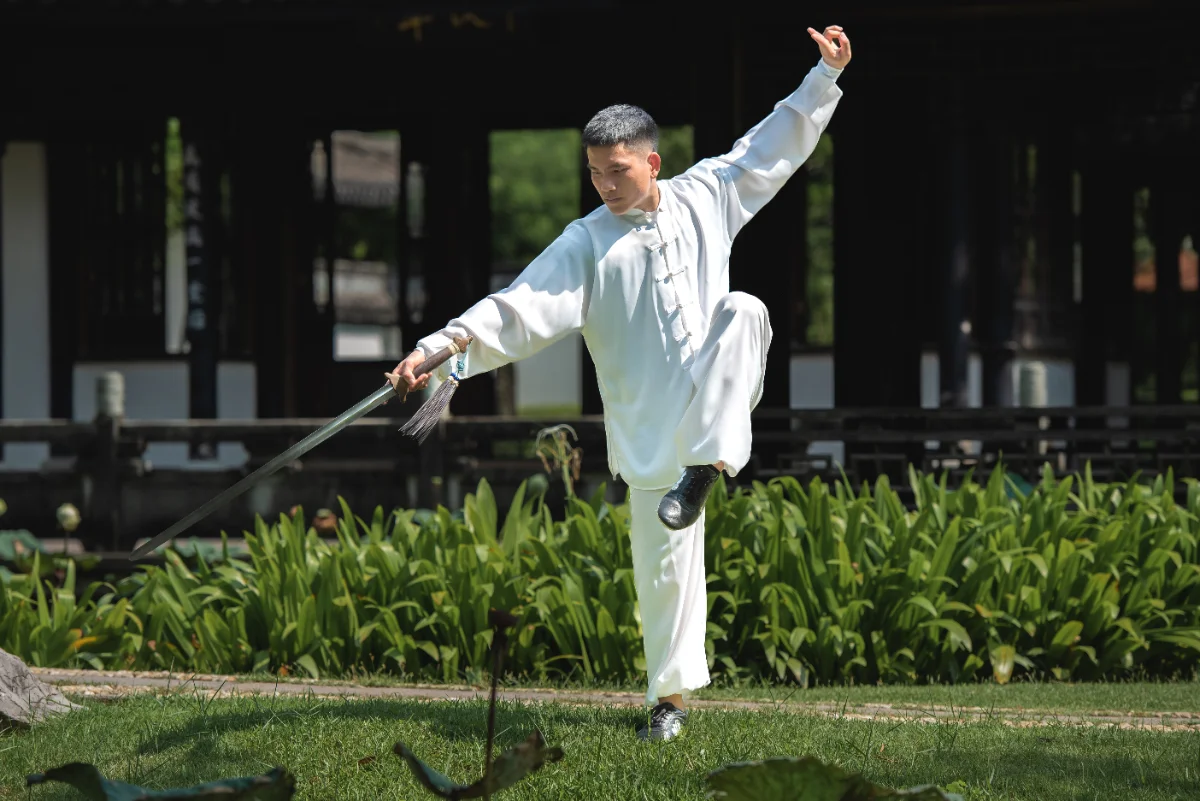
Once you’ve watched Tai Chi long enough, you’ll eventually see it: a practitioner moving through a graceful sequence with a slender straight sword extending the line of their arm, the blade tracing slow, elegant arcs through the air. This is Tai Chi sword, one of the most beautiful expressions of the art. If you’ve wondered what it is, whether you’ll ever get to try it, and what it adds to your practice, this introduction is for you.
What Is Tai Chi Sword?
Tai Chi sword is a weapons form, a choreographed sequence, like the empty-hand forms, but performed while holding a traditional straight sword known as the jian. The jian is light, slim, and double-edged, and in Tai Chi it’s treated not as a heavy weapon to be muscled around but as a delicate extension of the body, guided by the same relaxed, whole-body principles as the rest of the art.
The sword forms carry the familiar hallmarks of Tai Chi: slow (and sometimes quicker) continuous movement, deep rooting, waist-driven turning, and coordinated breath. But now those principles must extend all the way through the arm and out to the very tip of the blade, which makes the practice both challenging and deeply rewarding.
Tai Chi Is a Weapons Art
It sometimes surprises newcomers to learn that Tai Chi has a rich weapons tradition at all. But Tai Chi is a genuine martial art, and historically, mastery of the empty-hand forms was only part of the journey. Practitioners also trained with weapons, each of which develops different qualities. The most common Tai Chi weapons include:
- The straight sword (jian), light and precise, prized for elegance and refinement.
- The broadsword (dao), a curved, single-edged saber, more robust and vigorous in feel.
- The staff or spear, long weapons that develop whole-body power and extension.
- The fan, a graceful, expressive implement that opens and closes with a satisfying snap, popular for its beauty and accessibility.
At SOHMA, weapons forms including the sword and fan are part of the deeper curriculum, offered to students who have built a solid foundation in the empty-hand form.
What Sword Practice Develops
Picking up a weapon isn’t just for show, it develops real skill that flows back into your entire practice:
- Extension and connection. To move the sword correctly, the relaxed, connected energy of your body must travel all the way to the blade’s tip, the same whole-body connection rooted in your Dan Tian. This deepens your understanding of whole-body movement.
- Precision and focus. The sword demands exactness. Its point must go precisely where you intend, sharpening your concentration and body awareness.
- Wrist, forearm, and grip refinement. The subtle control required builds dexterity and a lighter, more sensitive touch.
- Balance and coordination. Managing an implement while moving through the form challenges, and improves, your stability and coordination.
- A fresh sense of joy. Many practitioners find weapons forms exhilarating and expressive, a wonderful way to renew their enthusiasm after years of empty-hand practice.
When Are You Ready to Learn the Sword?
Here’s the honest guidance most teachers give: weapons forms come after you’ve established a solid foundation in the empty-hand form. There’s a good reason for the traditional sequence. The sword doesn’t create Tai Chi principles; it expresses them. If your rooting, relaxation, and waist-driven movement aren’t yet established, the sword simply becomes something you wave around with your arm. But once those fundamentals are in place, the blade becomes a genuine extension of your well-trained body, and the practice comes alive.
So if you’re a beginner, think of Tai Chi sword as a beautiful goal on the horizon. Focus first on your foundation, the standing, the breathing, and a form like the Yang style 24 form, and the day you pick up the sword will be all the more rewarding for it.
Common Questions About Tai Chi Sword
What kind of sword is used in Tai Chi? Most commonly the jian, a light, slim, straight, double-edged sword treated as a graceful extension of the body. The curved dao (broadsword) is also used in some forms.
Is Tai Chi sword good for beginners? It’s usually learned after you’ve built a solid foundation in the empty-hand form, because the sword expresses Tai Chi principles rather than teaching them. Beginners are best served focusing on fundamentals first.
Do I need a real, sharp sword to practice? No. Practitioners typically learn with a practice sword, often a blunt metal, wooden, or flexible training sword, which is safe for learning the form.
What’s the difference between Tai Chi sword and broadsword? The straight sword (jian) is light and precise, emphasizing elegance and refinement, while the broadsword (dao) is a curved saber with a more robust, vigorous character.
Why practice weapons forms at all? Weapons forms deepen whole-body connection, precision, focus, and coordination, and they bring fresh joy and expression to a practice. They’re a natural next step once the empty-hand foundation is strong, building on the same Qi awareness described throughout Tai Chi.
Build Your Foundation with Tai Chi Mastery
Every weapons form begins with a strong empty-hand foundation, and that’s exactly what Tai Chi Mastery is designed to build. SOHMA’s online membership guides you step by step through the complete Yang style Tai Chi form, under the instruction of Chief Instructor Dr. Daniel Hoover, giving you the rooting, relaxation, and control that make weapons practice possible down the road.
Start with the fundamentals, and let the sword be the reward that awaits you.
Explore the Tai Chi Mastery membership and build your foundation today.
About Dr. Daniel Hoover
Dr. Daniel Hoover, DC, LAc, MH, CCSP®, integrates a rare fusion of clinical expertise and martial mastery to elevate the health of his patients and students. As a Doctor of Chiropractic, Licensed Acupuncturist, and 5th degree black belt in Shaolin Kempo, Dr. Hoover serves as the Chief Tai Chi Chuan instructor at the School of Healing Martial Arts™. His journey as an Ironman and Master Herbalist informs his unique understanding of how the body thrives under disciplined practice. To expand his impact beyond the local clinic, Dr. Hoover developed online Tai Chi courses, making these traditional healing arts accessible for any wellness journey. If you are ready to begin, we invite you to explore Tai Chi Mastery under the expert guidance of Dr. Daniel Hoover.